 Geeta-Kavita Collection of Hindi poems & articles
It is interesting to review your own life. As I am retired now from regular service, I had been thinking about it for some time. Finally I decided to write about different phases of my life in very brief. This exercise not only brought up floods of memories but gave me a perspective of my own life with its various shades. Here I am sharing this write-up with all readers. This was initially written as a series on LinkedIn. But including it on my website will give it a lasting existence. Your comments are welcome. Prof. Rajiv Krishna Saxena
Phases of Life- 1: मधुमास
Having recently crossed the age of 75, I looked back and mused about the best phases of my life. Was it the childhood and school days, college and university time, first professional job, mid career phase, senior positions with administrative responsibilities, first retirement phase, or finally the real senior citizen phase.
Generally, all of us have fond memories of childhood and college phase. Those are carefree days. Carefree because our parents and family do all the worries and shield us from the world. So if we consider phases when we were in control, childhood and school / college phase becomes out of the reckoning.
If we consider those phases of life when we were our own bosses, we first see it when we are doing professional degrees. For me, it was the PhD phase. That was a very hectic phase. National Science Talent Scholarship gave me the financial independence. Only Rs 400 per month, but that was sufficient those days (early 1970s).
In Hindi there is a term मधुमास . That is the period when we start serious interactions with the opposite sex and fall in love. We find our spouse during this phase. In all reckonings, this is actually the most pleasant and exiting phase of life. Yet as in the childhood phase, we are not totally in-charge during this phase. It is the nature acting through our hormones that make us experience “heaven on earth”.
I met my future wife during this phase. Both of us were doing PhD degrees at the AIIMS. My wife was an exchange student from Kathmandu and was so beautiful that I felt an inferiority complex! There were heart burns too. I recall hearing that her marriage was being fixed to someone else in Kathmandu and that was tormenting. All turned out well in end, and we got married even before completing our PhDs. We had a long courtship period of about 7 years.
AIIMS gives married accommodation to married students. We were given accommodation (a room and a kitchen in a shared 2BR flat) on campus. Shopping in Yusuf Sarai and cooking our food while writing
theses. It looks like a dream phase now. Our son was born and my wife walked directly from the laboratory to the maternity ward, both were on the third floor of AIIMS.
No other phase of life matches मधुमास in terms of sheer pleasure. We all spend the rest of our lives recalling that phase. Finding a spouse and procreation to give birth to a new life, are the most natural acts that constitute the essence of living. That is the reason most movies revolve
around this theme. In terms of Biology, nothing comes close.
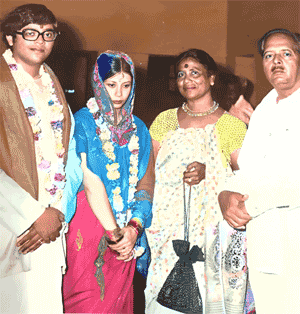
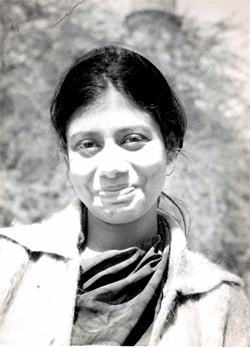
My wife, Queen Saxena (Year 1970)
Phases of Life – 2: First Job – A new beginning
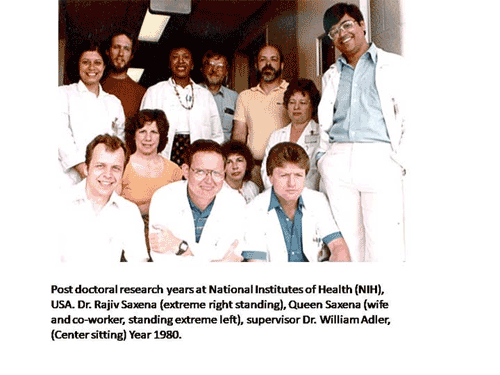
It was 4th of July, 1978 when I landed in Baltimore for post-doc. USA was the undisputed Mecca for fresh PhDs like me and I had written to about 20 well-known investigators to find a position for myself. I had a strong CV including a paper in Nature. I got four offers. I accepted the first offer from Bill Adler MD who headed the Clinical Immunology Section at the National Institute on Aging, NIH, in Baltimore. Bill had written a long letter detailing the priorities of his laboratory, and that impressed me.
When we look for a post-doc, we are never very rigid and any sub-area within our discipline may be chosen. I joined Bill’s laboratory. He was young, only about 12 years older than me and that was a positive point. Later I received offers from few other laboratories, including from one Nobel Laureate in Immunology. However, I had made my choice and didn’t want to disappoint Bill. Was it a good decision, I sometimes wonder? Association with a Nobel Laureate would have boosted my career. Bill’s lab was
a new one and had yet to establish itself. One good thing was that Bill offered a position to my wife too.
We rented a 2BR apartment nearby and I bought a used VW beetle to commute. Our son was now 1 year old and we needed someone to look after him as both of us were working. We were lucky to have found an elderly lady Mrs. Armstrong, who came in her oversized old car to pick
Gaurav in the morning and we picked him back in the evening. Pronouncing Gaurav was impossible for Mrs. Armstrong and she renamed him Gusha. Gusha Saxena thus became Gaurav’s American name.
We Stayed in Baltimore for about 6 years. We joined as NIH Visiting Fellows and after 3 years became Visiting Associates. Indians have ingrained habits that may look frugal to Americans. For example, we love hot self cooked food whereas Americans eat out a lot, and spend huge amount on food. With two salaries, we were very well off. Our car was junked in a bad road accident (that we survived unhurt, with God’s grace) and we bought a used Toyota Celica that lasted till the end of our stay in Baltimore.
Research-wise, we were doing very well. Immunology of aging was a new topic and scope to work was huge. Doing research in USA was so easy. Store had all research supply readily available and any reagent to-be-ordered could be procured overnight. In India, getting research supply was a project in itself.
Whatever we needed, Bill approved immediately. He also gave us full freedom to do research in the broad area of Immunology of Aging. As a result, our research productivity soared. Our focus on the new field of Natural Killer cells was especially productive. We published more than 30 research papers. That included one paper in Nature also. Bill acknowledged our contribution to his section in his farewell letter that I will share in next part of this series.
Phases of life – 3 – End of the post-doc phase
Prof. GP Talwar, our PhD supervisor from AIIMS, was building a new institute “National Institute of Immunology (NII)” in New Delhi. In the 5th year of our Post-doc in Baltimore, Prof Talwar visited us in Baltimore and told us about the new institute. He asked me and my wife to join the NII. Prof Talwar’s offer, if taken, would mean returning to India and a complete turnaround. It was the time we also had a daughter Garima, born in Baltimore, hence a US citizen.
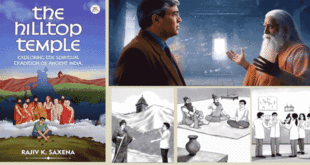
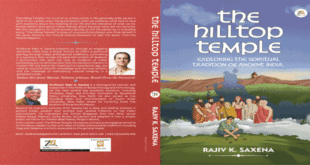
I had always wanted to return to India, as I wanted to be back to our roots. An additional reason was that a parallel spiritual path was gradually evolving within me. While professionally I was fully involved in research and writing papers, in my spare time, I avidly read the literature of Swami Vivekanand, and commentaries on Bhagwat Geeta. I have talked about it in my latest book “The Hilltop Temple”, which is a spiritual fiction tracing the evolution of our spiritual heritage in ancient India (Link: https://lnkd.in/gZQ3zeuJ) . This parallel path also pulled me towards India. Prof. Talwar’s offer appeared to be God-sent.
For Indians in USA, the default and easy option is to just keep staying in USA. It is easier because it avoids the huge exercise of translocation and uncertainties that would follow. We were however ready to take that plunge. Friends dissuaded us but I knew, if I did not try going back once, that remorse would never leave me. I told Bill Adler that we would return to India after a year. He too offered us regular positions at NIA, but I politely declined. He wrote us a long letter that I am posting below. There, he talks about our contributions and his apprehensions about what we could face upon returning to India.
The Baltimore phase of about 6 years was a very pleasant one. We often went to Inner Harbor to eat Crab Cakes for which Baltimore is famous. Unlike today’s generation of young Indians, that is too familiar with things American, we entered an entirely new world in 1978. The new world of malls, pizzas, donuts and enticing TV serials like All in the Family, The Lucy show, Taxi, and Barnie Miller. I think, that was the best time to live in America.
We had good savings that we regularly invested in FDs in different banks. Interest rates in USA were very high back then (12-15%) and we profited. It was mid February 1984, when we found ourselves at the Baltimore-Washington Airport, ready to board flight to New Delhi, via NY. It was a touchy moment. Immunology Section people had come to see us off at the Air Port. Weather played it’s trick and that night it snowed so much that all flights were cancelled. We spent the night on the airport, and could depart the next day only. We were on local TV news that showed us with our eight suitcases, stranded on the airport due to snow. A new life however awaited us in New Delhi…
Phases of Life – 4: A New Start in New Delhi
Returning to India after years of research in the U.S., we expected a smooth new beginning – but the reality was very different.
Living conditions were harsh. The weather was hot, salaries were modest and basic amenities like electricity and water supply were erratic. Even the children’s schools had poorly maintained facilities. On top, the tragic assassination of Indira Gandhi plunged Delhi into chaos.
The institute we had joined was in its formative stage and lacked facilities. For nearly a year, we felt we were simply wasting time. Meanwhile, we still had an open offer from Bill Adler to rejoin his lab, and we began seriously considering returning to the United States.
But as the saying goes, when the going gets tough, the tough get going. A turning point soon arrived. I applied for and was selected as an Associate Professor at Jawaharlal Nehru University (JNU). The university needed an immunologist to initiate teaching and research in this emerging field. Around the same time, my wife joined the Malaria Research Institute of the Indian Council of Medical Research.
Before leaving the United States, I had applied for a substantial research grant from the Department of Science and Technology (DST). Although it had been technically approved earlier, it was not funded because the institute where we were working was itself a DST institution. When I moved to JNU, however, the grant was finally released.
It turned out to be a significant grant. I was able to establish and equip a new laboratory and attract bright PhD students. Suddenly, life and work were back on track.
My wife loved greenery. With our savings from the United States, we bought a small farm on the outskirts of South Delhi. Around the same time, we were fortunate to receive the allotment of a new Maruti car. Our children were thrilled with the little red beauty.
Working in a university is perhaps one of the best environments for a researcher. It provides the freedom to pursue ideas at one’s own pace. Faculty politics can sometimes be challenging, but I managed.
Teaching was new for me. I soon realized that my knowledge of Immunology, was concentrated in specific areas. I therefore began reading widely and deeply across the subject. Over time, this helped me develop the comprehensive understanding expected of a professor. Students responded warmly to my courses, and securing a PhD position in my laboratory became quite competitive. My first PhD student completed her degree, and soon afterward, I was promoted to Full Professor at the age of 39.
The next turning point came when I was offered a two-year position as a Visiting Professor at the University of Pittsburgh. The proposal created considerable friction within the faculty, and most colleagues opposed granting me such a long leave. Yet this, too, is one of the strengths of the university system: despite the opposition, the leave was eventually granted.
Phases of Life – 5: Career at JNU
I spent 27 remarkable years at the School of Life Sciences, Jawaharlal Nehru University (JNU).
Spread over nearly 1,100 acres, the JNU campus is partly forested—an oasis amid the bustle of New Delhi. Living on campus was a unique experience. Evening walks often brought encounters with peacocks, nilgai, and occasionally foxes or snakes. It was a refreshing contrast to metropolitan life.
Campus politics at JNU has traditionally been influenced by left-leaning ideologies, and the university’s public image is often shaped by its strong social science schools. The scientific contributions of JNU’s science schools, though significant, rarely received the same public attention.
While I did not participate in campus politics, the JNU milieu taught me an important lesson: institutions thrive when diverse viewpoints coexist and are freely expressed. The culture of open debate and freedom of speech was deeply embedded in the university.
JNU played a crucial role in my professional growth. During my tenure, I was fortunate to take three long sabbaticals (two years each) to work internationally—at the Pittsburgh Cancer Institute, University of Pittsburgh School of Medicine (PA), NIOSH–Center of Disease Control, in Morgantown (WV), and the US-EPA (Environmental Protection Agency) in Durham (NC).
At JNU I guided around 20 PhD scholars, secured research grants worth several crores of rupees, and published over 110 research papers. It was also during this period that I had the honor of being elected to all three major science academies of India based in Bangalore, Allahabad and New Delhi.
In 2002, I was appointed Dean of the School of Life Sciences, and in 2005 I became Rector (Pro-Vice Chancellor) of JNU. Even while serving in these administrative roles, I continued to teach Immunology to MSc and PhD students, guide research scholars, and maintain my research activities. My research output slowed somewhat during my tenure as Rector, but the administrative experience proved invaluable.
Those years also saw major expansion of JNU’s academic infrastructure, including new buildings for the Schools of Art & Aesthetics, Physical Sciences, and Environmental Sciences, as well as a Convention Centre. I was closely involved in these projects and interacted regularly with the university architects—an entirely new and enriching experience.
In 2007, while on sabbatical at the US- EPA headquarters in North Carolina, I received a call from Prof. G. K. Chadha, former Vice-Chancellor of JNU. The Government of India was planning a new international university in New Delhi, and he invited me to join this project by taking deputation leave from JNU.
That call marked the beginning of the next phase of my journey at the South Asian University in New Delhi.
Phases of Life – 6: South Asian University – Formative Years
What does it take to build an international university—starting with nothing but an idea?
In October 2008, with permission from JNU, I joined the South Asian University (SAU) Project Office as an Officer on Special Duty (OSD). Building a university from scratch is always challenging—more so when it is envisioned as a truly international institution, jointly sponsored by all eight SAARC countries.
My mandate was clear, though far from simple: to develop the foundational framework of the university—Statutes, Regulations, Bye-laws, academic and governance structures, and the overall business plan.
The Steering Committee, comprising UGC Chairpersons and government nominees from all SAARC nations, was chaired by Prof. G.K. Chadha. As its Secretary—and of several subcommittees—I found myself at the center of a complex, multinational effort.
It did not take long to learn a crucial lesson: committees rarely write documents; they refine and approve them. The responsibility of drafting rests largely with the secretary. In effect, I single-handedly prepared the core documents of SAU, drawing upon countless examples from universities across the world. It was an intense, demanding process that spanned nearly two years.
The effort culminated at the SAARC Summit in Bhutan in 2010, where the Heads of States approved the university framework and directed us to operationalize SAU without delay.
What followed was a whirlwind.
With initial support from JNU in the form of temporary space, we began building the university from the ground up—recruiting faculty, selecting students, creating infrastructure, and even setting up hostel facilities. Prof. Chadha was appointed President, and I had the privilege of serving as the founding Vice President.
Our first academic session was launched with Master’s programs in Economics and Computer Science.
Soon after, the Government of India allocated the iconic Akbar Bhawan in Chanakyapuri—once a hotel, now repurposed into a functional academic space. Hotel rooms transformed into faculty offices and classrooms; multiple floors became hostels. It was an exercise in adaptation and imagination.
Alongside my role as Vice President, I also took on the responsibility of founding Dean of the Faculty of Life Sciences and Biotechnology. We recruited talented faculty from across the world, established laboratories, and launched MSc and PhD programs in quick succession.
Looking back, it was a period of relentless pace, constant problem-solving, and collective commitment. We were not just building systems—we were building an institution from the ground up.
When building something new, clarity of purpose and willingness to take ownership matter more than perfect structures. Institutions are ultimately shaped by people who step forward and do the work.
The next challenge was even bigger: creating a permanent campus for SAU…
Phases of Life – 7: SAU years -Administrative load and Research Output
My years at the South Asian University (SAU) were both rewarding and demanding. As an international university, SAU offered certain financial advantages, including US$-denominated, tax-free compensation. Compared to my time at Jawaharlal Nehru University, this phase was significantly more rewarding financially.
However, the role of Vice President came with intense administrative responsibilities. The demands of the VP’s office were such that I rarely found time to sit in my faculty office. Inevitably, when administration takes precedence, research output tends to suffer.
Even so, I never stopped teaching Immunology to MSc and PhD students. I was fortunate to work with an exceptional group of PhD students. With adequate research funding, we were able to establish a confocal microscopy facility, funded through a major DST grant of mine—an asset that benefited the entire Faculty of Life Sciences and Biotechnology.
One of the most challenging and exciting responsibilities was planning the new SAU campus. The Government of India allocated 100 acres of land in South Delhi for this purpose. A team of Indian and Nepali architects was selected through an open competition. I lead the team on visits to universities in China and Singapore. These visits helped us shape a clear and modern vision for the campus.
In June 2015, the foundation stone of the SAU campus was laid by Mrs. Sushma Swaraj (Minister of External Affairs). But the journey to that milestone was marked by a profound personal and institutional loss.
In March 2014, while I was in Chennai leading a UGC evaluation team, I received the shocking news that Prof. G. K. Chadha, the President of SAU, had passed away suddenly due to a heart attack. He had been not just a colleague, but a close friend since our days at JNU. His wisdom, warmth, and leadership left a lasting impact on all of us. In his memory, we later named the university library after him.
Following his passing, I served as Acting President for about a year, which further intensified my administrative responsibilities. Despite these demands, my students and I continued to make meaningful research contributions. We published around 15 papers from SAU, including one in the Proceedings of the National Academy of Sciences (PNAS), demonstrating how carbon nano-diamonds inhibited tumor metastasis in a mouse model.
I superannuated from SAU in January 2016, but my association with the university has continued as Professor Emeritus. It is deeply satisfying to see SAU steadily evolving into a respected center of learning, with ongoing campus development and growing academic recognition.
In the last 2 write-ups in this series, I shall summarize few career advices from my personal experiences that should be useful for young researchers / faculty. Finally, I would like to talk a bit about the parallel spiritual path that ran alongside my academic career.
Phases of Life – 8: Some Career Advice
Life passes quickly. Before we realize it, we are deeply immersed in our careers—and soon, we find ourselves approaching retirement. Along the way, we learn many lessons. The irony is that we rarely get the opportunity to apply these lessons fully in our own lives. In hindsight, we often feel we could have acted differently—but that chance seldom returns.
With this in mind, I thought of sharing a few reflections from my own journey that may be useful to younger researchers and teachers.
1. Focus, hard work, and visibility
Success rests on concentration and sustained hard work. Stay updated in your field—nothing can substitute for this. These qualities earn respect and admiration. However, if you wish to be recognized more widely, networking is equally important.
Do not remain aloof. Engage with colleagues within and beyond your institution. Attend meetings and conferences, and interact meaningfully. The impression you create matters. Strong professional relationships often lead to invitations, collaborations, and positions of responsibility.
Your work may be excellent—but people must know about it. A warm and approachable demeanor opens many doors. Networking requires effort; do not dismiss it as a distraction.
2. Learn to forgive and to apologize
At times, colleagues may act in ways that hurt you. Forgive them. Remember, we are all shaped by circumstances. Do not hold grudges—let go and move forward with grace. Equally, if your actions have hurt someone, do not hesitate to apologize. A sincere “sorry” goes a long way in preserving relationships.
3. Help others and respect autonomy
Extend help wherever you can. Treat your students, juniors and colleagues with empathy and genuine concern. Share your views, but do not impose them. Allow others the space to make their own decisions. It is neither necessary nor desirable to have your way every time. Do not be stingy with praise, where it is due.
4. Accept responsibilities with grace
Do not shy away from responsibilities. At times, assigned tasks may seem unimportant or time-consuming. Even so, try to contribute positively. Whether it is reviewing manuscripts or serving on committees, offer your support willingly and sincerely.
5. Make time for yourself
Amid professional and personal commitments, carve out time for yourself—early mornings often work best. Practices like meditation and pranayam can bring clarity, calmness, and inner stability—qualities that are invaluable in both life and career.
I will write a bit more on the last point in the concluding part of this series.
Phases of Life 9 – Profession and spirituality
In this part, let me shift gears from profession to spirituality. There are so many professions in this world. We happen to land in one of these purely by chance. Bhagwat Geeta says that whatever profession you land in, do it with most sincerity, but without attachment.
इस जग का सारा काम-काज, इक महायज्ञ के है समान,
सब लोगों के जो निर्धारित वे ही करने हैं नियत काम ।
इस ब्रह्मचक्र, इस महायज्ञ में नियत कर्म होते सबके ,
जो अनासक्त करते जायें यह कर्म, वही योगी सच्चे । (Baal Geeta, English translation in comments)
Our profession is something that keeps us busy in this world and doing it with utmost zeal is our duty. However, our profession is not the ultimate aim of our lives. True aim, as per our scriptures, is to investigate and attempt to find answers to eternal questions like the true nature of the universe, ourselves and the consciousness. Following this query is the universal dharma (essential duty) of all human beings irrespective of their profession, and it should go on in our lives on a path parallel to our profession.
This parallel path is spirituality, which is a very private endeavor. One must find time to devote to this endeavor. Our scriptures have laid down specific path to this enlightenment, and ignoring it makes our lives seem empty. My recent book, “The Hilltop Temple” explains this path and introduces the readers to the dharma that is endeavoring to find the true answers. “The Hilltop Temple” is an illustrated fiction novel, available on Amazon and most book-shops (Link below).
My spiritual path started with reading Vivekanand’s literature while I was in Baltimore. It has continued ever since. Meditation (Dhyan) started when I joined JNU and that too has continued. Regular practice of Dhyan and pranayam bring a steadiness in mind and you do not get perturb easily. The spiritual parallel path is thus very useful in professional as well as daily life.
Long time ago, I wrote about my own experiences of daily Dhyan. That was published on my website, and if you can read Hindi, it is available at : https://lnkd.in/g7pG-SQN
On this parallel path of mine, I translated Bhagwat Geeta into metered Hindi Shlokas (Geeta Kavya Madhuri, first published in 2002, https://lnkd.in/g5k54YdJ);
“Baal Geeta” (Penguin Books, Published 2010, https://lnkd.in/gmaK8Cxs);
And “The Hilltop Temple” (Zorba Books, 2025, https://lnkd.in/gZQ3zeuJ).
Our profession keeps us busy in this world, and we can through profession help others- as a teacher by educating, as scientist by discovering new insights, as a doctor by treating patients. But helping yourself comes through your own private spiritual path. I wish you all the best.