 Geeta-Kavita Collection of Hindi poems & articles
Intro
I present a brief account of a marriage I attended in a Haryana village Rajiv K. Saxena
A rural marriage in Haryana
A couple of years ago, we moved from New Delhi to Sohna, Gurugram. People wishing to escape the crowded areas of Delhi often move either to Gurugram in the south or to Noida in the east. Sohna, with its greenery, has become a popular destination. The area is developing fast — tall modern apartment buildings now dot the skyline, with more coming up regularly. Yet, the southern part of Gurugram district, around Sohna, remains far greener than the main Gurugram city.
+
Scattered amid these vast green stretches are several villages where farming is still the main livelihood. My car driver, Ravi Yadav, comes from one such village. A smart, punctual, and ever-smiling man, Ravi lives on his four-acre farm with his brothers, growing seasonal crops. With land prices being what they are, their small holding is worth at least Rs. 200 million today. Yet, they have no desire to sell — preferring instead to cultivate the soil that their forefathers left behind. They remain simple, rural folk, content with their land, crops, and cattle.
Ravi took a month’s leave recently, as the twin daughters of his elder brother were to be married on the same day. He was deeply involved in preparing for the grand event. After much effort by their extended Yadav family — spread across this region of Haryana — suitable bridegrooms had been found. Two wedding processions were expected to arrive on the same evening, making the organization even more challenging.
+
Ravi came to deliver the wedding invitation card with great pride. It was beautifully designed and printed in English — perhaps as a mark of status, since English has that aura in rural Haryana. He insisted that our entire family attend. I had never been to his village or to a village wedding before, so I looked forward to the experience.
+
That evening, after sunset, my son and I drove through winding hilly roads to the venue. The replacement driver, also from the same village, expertly navigated dark lanes between houses and fields. When we arrived, the wedding processions had not yet reached, but the venue was already crowded with villagers. In rural areas, social bonds run deep, and nearly every household in the village had been invited.
+
A large tent had been erected on a vacant field, with about a hundred cars parked nearby — a clear sign of the growing affluence of Haryana’s rural population. Ravi and his family greeted us with great warmth. As is customary, we had prepared envelopes with gift money for the newlyweds. At the entrance, a few men sat at a table collecting the envelopes and carefully recording the names of each donor (along with their fathers’ names) and the amounts given — a practice I had never seen at urban weddings.
+
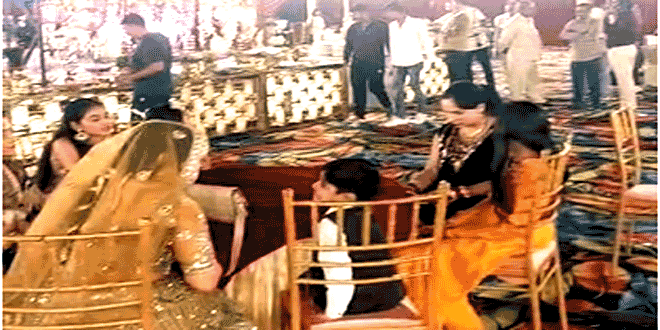
Inside, the scene was astonishing. Over an acre of carpeted ground, sofas and chairs were neatly arranged, surrounded by food stalls offering an impressive spread. Women in their best attire sat chatting and eating, while well-dressed children ran about happily. The vegetarian feast included pooris, naans, various sabzis, paneer and lentil dishes, along with chaat, aloo tikkis, noodles for the children, and a wide range of desserts — jalebis, gulab jamuns, gajar ka halwa, and ice cream. In its lavishness, the reception rivaled — even surpassed — many urban weddings I had seen.
+
“How could they afford all this?” I wondered. These “poor farmers” certainly did not look poor. Ravi and his seven-year-old son, both smartly dressed in suits, looked radiant. I soon understood the system: the entire village contributed to the wedding expenses. Each family’s contribution was carefully recorded, to be reciprocated when marriages were held in their families later. A remarkable community-based system that spread the financial burden among all!
+
As the grooms’ processions were yet to arrive, we finally took our leave — our hearts warmed and our stomachs full after a memorable evening.
Rajiv K. Saxena



This design is spectacular! You obviously know how to keep a
reader amused. Between your wit and your videos, I was almost moved to start my own blog (well, almost…HaHa!) Fantastic
job. I really enjoyed what you had to say, and more than that, how you presented it.
Too cool!